


On August 25, 2026, the Draft Law on Anti-Cross-Border Corruption of the People’s Republic of China (the "Draft Law") was submitted to the Standing Committee of the National People’s Congress for first reading. As China’s first dedicated legislation in this area, the Draft Law would establish an integrated framework for preventing and punishing cross-border corruption. The Draft Law is open for public comment until September 26, 2026, and remains subject to further revision. This alert analyzes the text currently released and its implications for Chinese enterprises operating abroad and multinational companies operating in China. (An unofficial English translation of the full text is annexed for reference)
For the purposes of this alert, "outside the territory of China" refers to Hong Kong, Macao and Taiwan, and all other countries and regions outside the Chinese mainland.
Key Takeaways
The Draft Law comprises six chapters and 47 articles addressing the scope of cross-border corruption, enforcement mechanisms, international cooperation, corporate integrity and compliance and legal liability, etc. Four developments merit particular attention:
-
Expanded jurisdictional reach: The Draft Law covers specified corruption conduct involving activities outside the territory of China where the results arise wholly or partly within the territory of China and expressly includes the flight of corruption suspects abroad and the cross-border transfer of corruption proceeds. This may expand the potential corruption risk perimeter for cross-border business activities.
-
Systematic and data-driven enforcement: The Draft Law establishes a national multi-agency coordination mechanism led by the National Commission of Supervision ("NCS") and provides for the referral of leads among authorities responsible for anti-money laundering ("AML"), tax, finance, audit, customs and other relevant areas, supported by big data and artificial intelligence. Cross-border fund flows, asset transfers and information held by different authorities may therefore become potential sources of investigation leads.
-
Greater conflicts between foreign investigation requirements and Chinese law: The Draft Law restricts institutions, organizations and individuals outside the territory of China from conducting cross-border corruption investigations in the Chinese mainland or providing related evidentiary materials without the consent of the relevant Chinese authorities. Multinational Corporations ("MNCs") operating in the Chinese mainland may therefore face more complex cross-border evidence collection and data compliance requirements when conducting internal investigations or responding to foreign enforcement authorities.
-
Integrity and compliance as a statutory obligation: The Draft Law establishes integrity and compliance obligations for enterprises engaged in cross-border business operations, covering compliance systems, risk assessment, internal controls, third party management and employee training. Failure to comply may result in rectification orders, suspension of relevant business, suspension of business operations for rectification, or revocation of relevant business licenses, increasing the importance of corporate compliance investment.
I. What Conduct Falls within the Scope of “Cross-Border Corruption” and Who May Be Covered?
Provisions: Chapter I (Art. 3)
Article 3:
For the purposes of this Law, “cross-border corruption” refers to the following acts:
(a) acts of offering bribes to foreign public officials or officials of public international organizations committed by citizens within the territory of China or by enterprises and other organizations within the territory of China and their branches and subsidiaries, or such acts committed within the territory of China by persons outside the territory of China or by enterprises and other organizations outside the territory of China and their branches;
(b) acts of offering bribes, committed by persons outside the territory of China or by enterprises and other organizations outside the territory of China and their branches, to public officials within the territory of China or their specific related persons, or to state organs, state-owned enterprises, public institutions or people’s organizations, as well as associated acts of accepting bribes;
(c) duty-related malfeasance or duty-related crimes such as embezzlement, bribery, abuse of power, dereliction of duty, rent-seeking, transfer of benefits, malpractices for personal gain, and waste of state assets, other than those specified in the preceding two subparagraphs, committed outside the territory of China by citizens within the territory of China or by enterprises and other organizations within the territory of China and their branches and subsidiaries;
(d) other acts of corruption of the same nature as those specified in the preceding three subparagraphs, where the acts were committed wholly or partly outside the territory of China, and the results arise wholly or partly within the territory of China;
(e) acts of persons suspected of corruption escaping or hiding outside the territory of China or transferring the proceeds of corruption across the border.
Insights
The Draft Law defines “cross-border corruption” broadly through five categories: (i) bribery of foreign public officials or officials of public international organizations by Chinese individuals and entities or within the territory of China; (ii) bribery by individuals and entities outside the territory of China involving public officials or specified entities within the territory of China, including associated acts of accepting bribes; (iii) specified duty-related offenses committed outside the territory of China by Chinese individuals and entities[1]; (iv) other corruption conduct occurring wholly or partly outside the territory of China where the results arise wholly or partly within the territory of China; and (v) the escape and hiding of corruption suspects or cross-border transfer of corruption proceeds. The scope covers both Chinese and foreign individuals and entities:
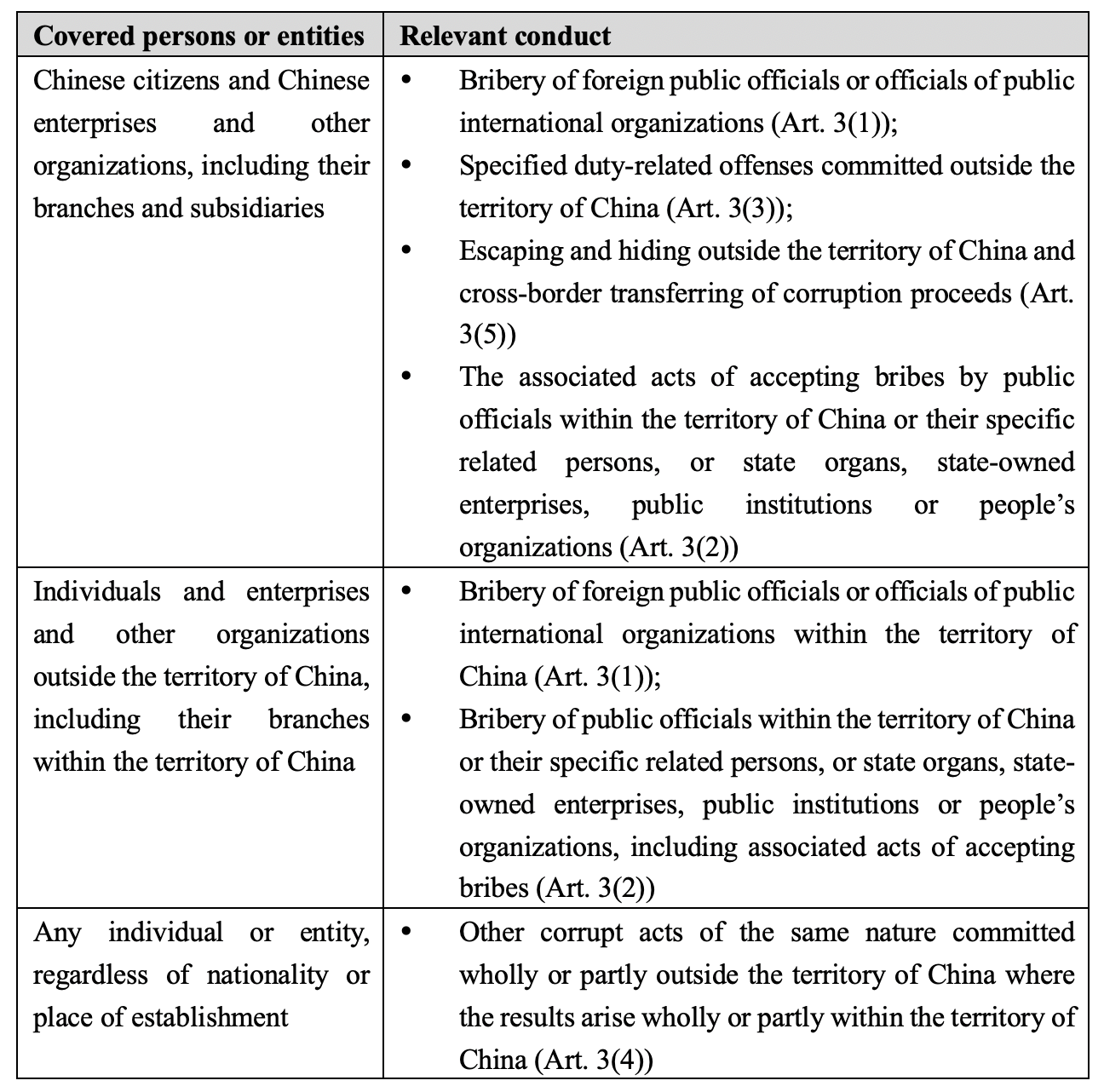
Article 3(4) is particularly significant because it establishes a results-based connection to the territory of China. The Draft Law does not define when a result is considered to arise wholly or partly within the territory of China. For example, the provision could potentially be relevant where an overseas transaction involves Chinese accounts, assets or business operations. The scope of this provision will therefore depend on subsequent legislative clarification and enforcement practice.
Article 3(5) separately addresses the escape and hiding of corruption suspects outside the territory of China and the cross-border transfer of corruption proceeds, providing a basis for the fugitive and asset recovery mechanisms under Chapter III of the Draft Law.
II. How Will China Organize and Investigate Cross-Border Corruption?
Provisions: Chapter II (Arts. 7-16)
Article 7:
The state shall establish a working mechanism for anti-cross-border corruption to organize, coordinate and guide efforts in this regard, and shall perform the following duties:
(a) conducting comprehensive analysis and assessment of the overall situation regarding anti-cross-border corruption, researching and drafting relevant policies, and formulating and issuing guidelines on anti-cross-border corruption;
(b) coordinating the development of relevant systems for anti-cross-border corruption;
(c) coordinating law enforcement and judicial work in anti-cross-border corruption;
(d) guiding relevant departments and local authorities in carrying out work against cross-border corruption;
(e) urging the relevant competent authorities and other entities to improve their integrity and compliance management systems, and to provide guidance on the identification, assessment, early warning and response to cross-border corruption risks; and
(f) examining and resolving other major issues arising in the work of anti-cross-border corruption.
Article 8:
The national mechanism for anti-cross-border corruption shall be led by the National Supervisory Commission, with the Ministry of Foreign Affairs, Ministry of Public Security, Ministry of Justice, Ministry of Finance, Ministry of Commerce, the administrative department in charge of anti-money laundering, the National Audit Office, the State-owned Assets Supervision and Administration Commission of the State Council, the National Financial Regulatory Administration, the China Securities Regulatory Commission, and the Cyberspace Administration of China, as well as other relevant authorities, jointly carrying out work against cross-border corruption in accordance with their respective responsibilities and division of tasks.
The National Supervisory Commission shall be responsible for the day-to-day operations of the working mechanism, organize and coordinate the investigation and handling of major cross-border corruption cases in accordance with the law, and carry out international cooperation on anti-cross-border corruption in conjunction with relevant authorities.
The Supervisory Commissions of provinces, autonomous regions and municipalities directly under the Central Government shall take the lead in anti-cross-border corruption work within their respective administrative regions. Provinces, autonomous regions and municipalities directly under the Central Government may, in light of work needs, establish local work mechanisms for anti-cross-border corruption.
Supervisory bodies and supervisory commissioners dispatched or assigned by supervisory commissions at all levels shall, in accordance with the authorization granted by the dispatching bodies and in accordance with their administrative powers, lawfully carry out work relating to anti-cross-border corruption.
Article 9:
Supervisory authorities, public security organs, procuratorial organs and judicial organs shall, in their work against cross-border corruption, perform their functions of state supervision, investigation, prosecution and adjudication in accordance with the law. Where, in the course of handling cases, they discover problems in the work of relevant competent authorities in anti-cross-border corruption, they may submit written opinions and recommendations to promote improved governance and institutional reform. The relevant competent authorities shall address these matters in a timely manner and provide written feedback.
Article 10:
Departments such as commerce, state-owned asset supervision and administration, market supervision and administration, and financial supervision and administration shall, in conjunction with supervisory authorities and public security organs, establish and improve long-term mechanisms against cross-border corruption in their industries, monitor, analyze and provide early warning of risks regarding cross-border corruption in the relevant industry sectors, and strengthen supervision and administration of industry sectors prone to cross-border corruption.
Relevant industry associations, chambers of commerce and similar bodies shall, in accordance with laws, regulations and their articles of association, play a coordinating and self-regulatory role; guide their members in strengthening integrity and compliance; provide members with services such as information and advice, and the protection of their rights and interests; and promote lawful cross-border business operations within the industry.
Article 11:
The authorities and organizations responsible for the appointment and removal of public officials shall, in accordance with their respective management powers, strengthen the education, management and supervision of public officials, and prevent and address acts of cross-border corruption by public officials in accordance with the law.
Article 12:
Supervisory authorities shall, together with the relevant authorities, strengthen the supervision and rectification of public officials’ acquisition, in violation of applicable provisions, of foreign nationality or of permanent residence status or long-term residence permits outside the territory of China; improve the reporting system for public officials’ deposits and investments outside the territory of China; and establish and improve early-warning mechanisms, blocking mechanisms and accountability mechanisms for preventing escapes and the cross-border transfer of the proceeds of corruption.
Article 13:
The administrative department in charge of anti-money laundering and other departments and institutions legally responsible for anti-money laundering supervision and management shall, in accordance with the law, guide financial institutions and specified non-financial institutions to strengthen the monitoring of cross-border funds.
Where the competent administrative authority of anti-money laundering under the State Council, or any of its dispatched offices at or above the level of a city divided into districts, discovers any suspicious transaction activity related to cross-border corruption, it may conduct an investigation in accordance with the law, and shall promptly transfer the clues and relevant evidentiary materials of cross-border corruption to the supervisory authorities and public security organs.
Article 14:
Where auditing, finance, taxation, and financial supervision and management departments, in the course of conducting supervision and inspection over relevant organizations and individuals in accordance with the law, discover that the inflow and outflow of funds and transfer of assets are suspected of involving cross-border corruption offences, they shall promptly transfer the relevant clues and evidentiary materials to the supervisory authorities and public security organs.
Where the information reported by the customs to the competent administrative authority for anti-money laundering in accordance with the law, concerning cash and bearer payment instruments carried by persons entering or leaving the country, is suspected of involving cross-border corruption offences, the competent administrative authority for anti-money laundering shall promptly transfer the relevant clues and evidentiary materials to the supervisory authorities and public security organs.
Article 15:
In their work against cross-border corruption, the relevant authorities shall, in accordance with the law, utilize information technology tools such as big data and artificial intelligence, integrate various types of supervisory information resources, strengthen comprehensive data analysis and assessment, and promote the timely early warning of risks and the precise identification of problems.
Article 16:
The relevant authorities shall organize and carry out publicity and education campaigns against cross-border corruption through means such as legal education and the use of case studies to illustrate the law, thereby enhancing the whole of society’s awareness and capabilities.
Organizations such as news agencies, radio and television stations, cultural institutions and internet information service providers shall carry out targeted public awareness and education campaigns on anti-cross-border corruption.
The State encourages and supports qualified institutions of higher education, scientific research institutions, and other organizations to conduct basic research on anti-cross-border corruption and to strengthen the education and training of personnel.
Insights
-
NCS-led multi-agency mechanism: The national work mechanism is led by the NCS, with relevant State Council departments participating according to their respective mandates. The NCS is responsible for daily coordination, major case handling and international cooperation.
-
Lead discovery and referral: The Draft Law requires authorities governing AML, audit, tax, finance, customs and other relevant areas to identify and refer relevant leads and requires the authorities to deploy big data and AI analytics across supervisory information resources. For companies, cross-border fund flows, asset transfers and other regulatory information may therefore become sources of investigation leads.
-
Industry-level governance and public education: Sectoral regulators must build long-term mechanisms against cross-border corruption in their industries; industry associations and chambers of commerce must guide members on integrity and compliance; and awareness campaigns extend across media and education.
III. What Case-Handling Tools are Available at the Domestic Level?
Provisions: Chapter III (Arts. 17-20)
Article 17:
Any organization or individual shall have the right to report cross-border corruption acts. The relevant organs shall promptly handle such reports in accordance with law, keep the identities of the reporting persons confidential, and reward and protect reporting persons who provide effective information in accordance with applicable provisions.
Article 18:
In the course of handling cases of cross-border corruption, relevant authorities such as supervisory authorities and public security organs shall have the right, in accordance with the law, to seek information from relevant organizations and individuals and to collect and obtain evidence. The relevant organizations and individuals shall actively cooperate and provide relevant evidence materials truthfully.
In the course of handling major cross-border corruption cases, supervisory authorities, public security organs and other relevant authorities may, in accordance with the principle of reciprocity, request foreign enterprises and other organizations to cooperate in accordance with the law.
Article 19:
Supervisory authorities, public security organs, and other relevant authorities may, in order to prevent persons suspected of committing acts of corruption from escaping or hiding outside the territory of China, decide to take exit restriction measures in accordance with the conditions and procedures prescribed by law, which shall be enforced by the immigration authorities in accordance with the law.
Article 20:
Where necessary for work against cross-border corruption, supervisory authorities, public security organs and other relevant authorities may, in accordance with relevant national regulations, request inspection authorities such as customs and immigration authorities to facilitate customs clearance for the persons concerned. The relevant inspection authorities shall provide assistance in accordance with the law.
Insights
-
Reporting channels and duties to cooperate: Anyone may report cross-border corruption; the authorities must process reports, keep the identity of reporting persons confidential, and reward those providing effective information. Authorities may inquire of relevant organizations and individuals and collect evidence in accordance with law, while relevant organizations and individuals are required to cooperate and truthfully provide evidentiary materials. Notably, in major cases, foreign enterprises and other organizations may also be requested to cooperate on a reciprocity basis.
-
Exit restrictions and clearance facilitation: To prevent flight, relevant authorities may impose exit restriction measures through the immigration authorities; conversely, customs and immigration facilitation may be arranged where needed for anti-cross-border corruption.
IV. How Will International Cooperation Be Carried Out?
Provisions: Articles 21-25
Article 21:
Supervisory authorities, public security organs and other relevant authorities shall, in accordance with the laws of the People’s Republic of China, international treaties and agreements concluded or acceded to by the People’s Republic of China, or in accordance with the principles of equality, reciprocity and consensus, carry out law enforcement and judicial cooperation and mutual legal assistance with relevant authorities outside the territory of China in matters such as the recovery of fugitives and stolen assets, joint investigations, evidence collection and exchange of information, so as to jointly prevent and punish acts of cross-border corruption.
Article 22:
Supervisory authorities, public security organs, and other relevant authorities may, in handling cross-border corruption cases, in accordance with the law, request relevant authorities outside the territory of China to provide the following forms of mutual legal assistance:
(a) locating and identifying relevant persons;
(b) inquiring about and verifying information relating to property and financial accounts involved in the case;
(c) obtaining and providing testimony or statements from relevant persons;
(d) obtaining and providing relevant documents, records, electronic data and items;
(e) obtaining and providing expert opinions;
(f) conducting an inquest or examination;
(g) searching persons, articles, premises and other relevant locations;
(h) arranging for witnesses to give evidence or assist with the investigation;
(i) sealing, seizing or freezing property related to the case;
(j) confiscating and returning illegal gains and other property involved in cases;
(k) serving legal documents;
(l) other matters relating to mutual legal assistance.
Article 23:
Evidence obtained by relevant authorities, such as supervisory authorities and public security organs, through channels including international law enforcement and judicial cooperation and mutual legal assistance, may be used as evidence if, upon examination, it meets the statutory requirements, except where international treaties or agreements, or commitments made by the People’s Republic of China, stipulate that such evidence shall not be used.
Article 24:
Where, in the course of handling cross-border corruption cases, supervisory authorities, public security organs and other relevant authorities discover that a person under investigation or a suspect has escaped or hidden outside the territory of China, they may cooperate with relevant authorities outside the territory of China through means such as extradition, the transfer of sentenced persons, repatriation or prosecution abroad, to apprehend the fugitive and bring them to justice in accordance with the law.
Article 25:
Supervisory authorities, public security organs and other relevant authorities may, in accordance with the law, recover assets derived from cross-border corruption through procedures such as law enforcement and judicial cooperation, mutual legal assistance and the confiscation of proceeds of crime, as well as through measures such as ordering restitution and accepting voluntary surrender.
Supervisory authorities, public security organs and other relevant authorities may, in accordance with the laws of the People’s Republic of China, international treaties and agreements concluded or acceded to by the People’s Republic of China, or in accordance with the principles of equality, reciprocity and consensus, cooperate with relevant authorities outside the territory of China on the return and sharing of assets.
Insights
-
Multiple legal bases for cooperation and broad mutual legal assistance: The Draft Law provides for international cooperation based on Chinese law, applicable international treaties or agreements, or the principles of equality, mutual benefit and consensus through consultation. The Draft Law also enumerates mutual legal assistance items, from locating persons and verifying financial account information, to obtaining testimony, searches, freezing, confiscation and return of assets, and service of documents, closely tracking China’s International Criminal Justice Assistance Law (“ICJAL”) issued in 2018.
-
Evidentiary use of foreign-obtained evidence: Evidential materials obtained through international cooperation may be used as evidence if, upon review, they meet China's statutory requirements, unless otherwise provided by an applicable international treaty or agreement or by China’s international commitments. The Draft Law does not further specify how this review will interact with Chinese criminal evidentiary requirements. Because evidence collection outside the territory of China follows the law of the place of evidence collection rather than Chinese criminal procedures, how the two standards interlock warrants close attention.
-
Fugitive and asset recovery: The Draft Law provides for international cooperation in pursuing fugitives and recovering corruption proceeds, including extradition, repatriation, overseas prosecution, confiscation and return of assets, together with relevant procedures under China’s Criminal Procedure Law.
V. What Restrictions Apply to Foreign Investigations into Cross-Border Corruption in China?
Provisions: Chapter III (Arts. 26-27)
Article 26:
Relevant authorities shall, on the basis of the laws of the People’s Republic of China or international treaties and agreements concluded or acceded to by the People’s Republic of China, or in accordance with the principles of equality, reciprocity and consensus, handle requests submitted by relevant institutions outside the territory of China for law enforcement and judicial cooperation and mutual legal assistance in cross-border corruption matters.
Without the consent of the relevant Chinese authorities, agencies, organizations and individuals outside the territory of China shall not, either on their own or through others, conduct investigations into cross-border corruption or other law enforcement activities within the territory of China; nor shall institutions, organizations and individuals within the territory of China provide evidence, materials or other relevant assistance to institutions, organizations or individuals outside the territory of China. Where the provisions of the laws of the People’s Republic of China are violated, relevant measures, such as blocking, shall be taken in accordance with the relevant national regulations, and legal liability shall be pursued in accordance with the law.
Article 27:
In respect of cross-border corruption cases where China is currently conducting investigations, prosecutions or trials; where a final judgment has already been rendered; where criminal proceedings have been terminated; where the statute of limitations for prosecution of the crime has expired; or where there are other circumstances under which judicial assistance may lawfully be withheld, the relevant authorities may refuse to provide assistance to the relevant institutions outside the territory of China.
Insights
-
The Draft Law requires foreign investigations and related assistance to proceed through lawful channels recognized under Chinese law. Echoing Article 4(3) of the ICJAL, the Draft Law stipulates that, without the consent of the relevant Chinese authorities, institutions, organizations and individuals outside the territory of China may not conduct cross-border corruption investigations or other law enforcement activities within the territory of China, whether directly or through others. Individuals and entities within the territory of China are likewise restricted from providing evidentiary materials or other related assistance to parties outside the territory of China.
-
A potential conflict may arise where a foreign parent company is subject to a foreign anti-corruption investigation and relevant individuals, communications, contracts or financial records are located within the territory of China. A foreign authority’s request should therefore not automatically be treated as a sufficient legal basis for transferring evidence outside the territory of China. Companies should assess the requesting authority, its legal mandate and the nature of the requested materials before determining the appropriate channel for cooperation.
-
A foreign regulator’s request for assistance may also be refused in certain scenarios, for example, where China’s own investigation, criminal investigation, prosecution or trial is ongoing; a legally effective judgment or ruling has been rendered; the criminal procedure has been terminated; or the limitation period for prosecution has expired.
VI. What Integrity and Compliance Obligations Will Apply to Cross-Border Businesses?
Provisions: Chapter IV (Arts. 29-34)
Article 29:
Enterprises engaged in cross-border business operations shall comply with the requirements of the laws and regulations of China, regulatory provisions, and relevant international treaties and agreements; observe business ethics, professional ethics, industry standards and codes of conduct; operate with integrity and in compliance with law; and urge and guide their branches and subsidiaries outside the territory of China to comply with the relevant legal provisions of the countries in which they are located.
For the purposes of this Law, “enterprises engaged in cross-border business operations” refers to enterprises within the territory of China that have established branches, subsidiaries or undertake investment activities outside the territory of China, as well as branches and subsidiaries established within the territory of China by enterprises outside the territory of China.
Article 30:
Enterprises engaged in cross-border business operations shall, in accordance with their scale, scope of business and revenue, formulate integrity and compliance management systems, improve integrity and compliance operational mechanisms, promptly investigate and address non-compliant conduct, and integrate integrity and compliance management throughout the entire process of decision-making, execution and supervision of cross-border business operations.
Enterprises within the territory of China engaged in cross-border business operations shall establish appropriate integrity and compliance management departments or appoint dedicated personnel; they may formulate separate integrity and compliance management systems for their cross-border business departments and branches or subsidiaries outside the territory of China; and, in accordance with actual circumstances, dispatch integrity and compliance officers to institutions outside the territory of China and develop guidelines and a checklist for the performance of duties by such officers.
Article 31:
Enterprises engaged in cross-border business operations shall carry out identification and assessment of integrity risks associated with such operations, improve their internal whistleblowing mechanisms, issue timely warnings and deal appropriately with any identified integrity risks, and implement targeted monitoring and improvement measures. Where suspected cases of cross-border corruption are discovered, they shall report such matters to the relevant authorities, such as supervisory authorities and public security organs, in accordance with the law.
State-owned enterprises shall strengthen the prevention and control of integrity risks relating to key posts, significant funds and major projects outside the territory of China; in accordance with relevant regulations, they shall adopt measures such as the direct appointment of financial officers outside the territory of China, the rotation of staff outside the territory of China and the avoidance of conflicts of interest, and shall strengthen the supervision and management of their employees, funds and projects outside the territory of China.
Article 32:
Enterprises engaged in cross-border business operations shall establish and improve their financial and accounting systems in accordance with the law, ensuring that accounting vouchers, accounting ledgers, financial and accounting reports and other accounting materials relating to cross-border operations are true and complete, and shall not use financial and accounting means to commit, conceal or cover up acts of cross-border corruption.
Enterprises within the territory of China engaged in cross-border business operations shall strengthen financial management of their cross-border business departments and branches and subsidiaries outside the territory of China, standardize accounting practices, and reinforce internal audits, and promote improvements in the level of integrity and compliance in business management.
Article 33:
Enterprises engaged in cross-border business operations shall conduct due diligence on any third-party organizations or individuals they engage, exercise supervision and management over them, establish and improve relevant integrity risk prevention mechanisms, and require third-party organizations or individuals acting on behalf of the enterprise to strictly comply with the enterprise’s code of conduct on integrity and compliance. They shall not use third-party organizations or individuals to commit cross-border corruption.
Enterprises within the territory of China engaged in cross-border business operations shall require their branches and subsidiaries outside the territory of China to implement the enterprise’s supervision and management system regarding third-party organizations or individuals.
Article 34:
Enterprises engaged in cross-border business operations shall strengthen integrity education for their staff and promote a heightened awareness of integrity in the workplace.
Enterprises within the territory of China engaged in cross-border business operations shall advocate for and promote the development of a corporate integrity culture, provide integrity and compliance training to staff in their cross-border business departments and to staff in their branches and subsidiaries outside the territory of China, and ensure that they understand and comply with the enterprise’s integrity and compliance management systems and risk prevention and control requirements.
Insights
The Draft Law separately imposes integrity and compliance obligations on “enterprises engaged in cross-border business operations.” Article 29 defines this term to include (i) enterprises within the territory of China that establish branches or subsidiaries outside the territory of China or carry out investment activities there, and (ii) branches and subsidiaries established within the territory of China by enterprises outside the territory of China. MNCs’ branches and subsidiaries within the territory of China therefore fall directly within the statutory compliance framework, while Chinese enterprises may be covered even without establishing an entity outside the territory of China if they carry out investment activities outside the territory of China. Specifically, the Draft Law builds a full-cycle compliance framework:
-
Compliance systems and personnel: Integrity and compliance systems must be established, with relevant departments or personnel designated.
-
Risk assessment and reporting: Integrity risks must be identified and assessed, internal reporting and early warning mechanisms must be established, identified risks must be remediated and suspected cross-border corruption reported in accordance with law.
-
Books and records and financial controls: Authentic and complete books and records must be maintained, financial or accounting arrangements may not be used to commit or conceal corruption, and Chinese enterprises must strengthen financial management and internal audit of operations outside the territory of China.
-
Third party management: Due diligence and ongoing supervision must be conducted in respect of third parties, relevant integrity standards must be incorporated into their engagement and performance, and third parties shall not be used to commit cross-border corruption.
-
Compliance training: Integrity education and compliance training must be provided to employees, including personnel working in operations outside the territory of China.
The key development is that integrity and compliance requirements previously reflected primarily in regulatory guidance for overseas operations would become statutory obligations, with specific legal consequences for non-compliance (see details below).
VII. What Are the Consequences of Violating the Draft Law?
Provisions: Chapter V (Arts. 35-45)
Article 35:
Where an enterprise, other organization or individual commits a cross-border corruption act that constitutes a crime provided for in the Criminal Law of the People’s Republic of China, criminal liability shall be pursued in accordance with law.
Article 36:
Where enterprises, other organizations or individuals commit acts of cross-border corruption that violate the order of administrative management and warrant administrative penalties, the relevant competent authorities shall impose administrative penalties in accordance with the law.
Where enterprises or other organizations commit the acts specified in the preceding paragraph, administrative penalties shall be imposed on the persons directly in charge and the other persons directly responsible in accordance with the preceding paragraph.
Upon completion of the investigation into a cross-border corruption case by the supervisory authorities or the public security organs, where administrative penalties are to be imposed on the person under investigation or the suspect, the case shall be referred to the relevant competent authorities in accordance with the law.
Article 37:
Where a public official commits acts of cross-border corruption, a sanction shall be imposed in accordance with law by the supervisory authority or by the organ or organization responsible for their appointment and removal.
Where enterprises or other organizations commit acts of cross-border corruption, sanctions shall be imposed in accordance with the law on the public officials among the responsible leaders and those directly responsible.
Article 38:
Where enterprises, other organizations or individuals commit acts of cross-border corruption, thereby resulting in financial loss or other damage, they shall bear civil liability in accordance with the law.
Article 39:
Where enterprises, other organizations or individuals are penalized for violating the provisions of this Law, such penalties shall be recorded in their credit records in accordance with relevant national regulations; where laws or administrative regulations contain prohibitions or restrictions on their engagement in relevant business activities or professions, such provisions shall prevail.
Article 40:
Where enterprises, other organizations or individuals commit acts of cross-border corruption, their illegal and criminal gains derived therefrom, and the fruits and proceeds thereof, shall be confiscated or recovered, or subject to an order of restitution, in accordance with law.
Article 41:
Where multiple actors jointly commit acts of cross-border corruption, they shall be penalized or sanctioned separately according to the role each played in the joint violation or joint crime and the legal liability each is to bear.
Whoever instigates or assists another person to commit a cross-border corruption act shall be penalized or sanctioned for the act so instigated or assisted.
Article 42:
Enterprises, other organizations and individuals that commit acts of cross-border corruption shall be subject to more severe administrative penalties and sanctions under any of the following circumstances:
(a) committing cross-border corruption acts on multiple occasions;
(b) committing a further cross-border corruption act after having been held legally liable for a cross-border corruption act;
(c) refusing to turn over the illegal gains or to make restitution;
(d) causing serious harmful consequences to the interests of the State or the public interest by committing cross-border corruption acts; or
(e) other circumstances in which laws or regulations provide for a heavier administrative penalty or sanction.
Article 43:
Enterprises, other organizations and individuals that have committed acts of cross-border corruption may be given a lighter or mitigated administrative penalty or sanction under any of the following circumstances:
(a) voluntarily surrendering and truthfully confessing the act;
(b) actively cooperating in the investigation and voluntarily providing relevant materials;
(c) voluntarily taking remedial measures, actively returning the illegal gains, and effectively reducing or avoiding losses;
(d) reporting the cross-border corruption acts of other persons, which is verified to be true; or
(e) other circumstances in which laws or regulations provide for a lighter or mitigated administrative penalty or sanction.
Article 44:
Where relevant organizations or individuals violate the provisions of this Law, refuse to provide evidence, conceal, falsify or destroy evidence, or refuse or obstruct investigations into cross-border corruption, they shall be ordered to rectify the situation by their employing organ, competent authority, superior body, supervisory authority or public security organs. Where the conduct constitutes a violation of public security administration, a public security administrative penalty shall be imposed in accordance with law; where it constitutes a crime, criminal liability shall be pursued in accordance with law.
Article 45:
Where an enterprise engaged in cross-border business operations fails to fulfil the integrity and compliance obligations under this Law, the relevant competent authority shall order it to rectify the situation within a specified time limit; where it refuses to rectify, the authority may order the suspension of the relevant business operations or of business operations for rectification, or the revocation of the relevant business license or permit. Where the aforesaid acts also contravene the provisions of other laws and regulations, legal liability shall be pursued in accordance with the law.
Insights
-
Liability for cross-border corruption itself: The Draft Law primarily connects existing liability regimes rather than creating a separate offense code: (i) where the conduct constitutes a crime, criminal liability arises under the Criminal Law; (ii) administrative penalties may apply to violations of the administrative management order, including those individuals directly in charge and other directly responsible individuals; (iii) involved public officials may face disciplinary actions; and (iv) civil liability may arise for damage caused. Joint actors are treated according to their roles, those who instigated or assisted others in committing the violations or crimes could also be held liable.
– Aggravating and mitigating factors: Repeated conduct, reoffending after legal liability, refusal to disgorge illegal proceeds and serious harm to state or public interests may result in more severe consequences, while voluntary surrender and confession, cooperation, remediation and disgorgement, and verified reporting of others may support mitigation.
– Collateral consequences: Relevant violations may be recorded in credit records, and statutory restrictions may apply to relevant businesses or professions. Additionally, illegal or criminal gains, together with their fruits and proceeds, may be subject to confiscation, recovery or restitution.
-
Liability for obstruction of investigations: Refusing to provide evidence, concealing, falsifying or destroying evidence, or refusing or obstructing an investigation may result in a rectification order, public security administrative penalties or criminal liability, depending on the circumstances. These provisions broadly apply to any relevant organization or individual, not only to investigation subjects.
-
Liability for failure to maintain integrity and compliance: The Draft Law creates a distinct compliance consequence for enterprises engaged in cross-border business operations. Failure to perform the integrity and compliance obligations under Chapter IV of the Draft Law may result in a rectification order; and, if the enterprise fails to rectify, suspension of the relevant business, suspension of business operations for rectification or revocation of relevant business licenses. It is worth noting this liability does not depend on the finding that the enterprise has engaged in cross-border corruption.
– From a comparative perspective, this approach is consistent with the broader trend in major anti-corruption regimes toward treating the adequacy of a company’s compliance framework as an independent regulatory concern, rather than merely as a factor relevant to liability for an underlying bribery offense. For example, the UK Bribery Act 2010 makes the failure of a commercial organization to prevent bribery a separate corporate offense, subject to the defense that the organization had adequate procedures in place.
– For enterprises engaged in cross-border business operations, this creates a practical need to comply with integrity obligations. Particularly, enterprises should be prepared to demonstrate not only that the relevant compliance framework has been formally established, but also that it is operating effectively in practice and that identified deficiencies are promptly addressed and documented.
[1] These specified duty-related offenses are in accordance with investigation scope by supervisory commissions set out in the Supervision Law.
Please click "Download" at the end of the article to access the annex: Law of the People's Republic of China on Combating Cross-Border Corruption (Draft).