


I. Introduction
On June 8, 2026, the National Medical Products Administration, jointly with the National Health Commission, the National Administration of Traditional Chinese Medicine, and the National Disease Control and Prevention Administration, officially released the newly revised Good Clinical Practice (Order No. 50 of 2026, the “2026 Revised GCP”). The 2026 Revised GCP entered into effect on September 1, 2026, superseding the previous Good Clinical Practice (Order No. 57 of 2020, the “2020 Original GCP”), which had been in force since July 1, 2020.
Driven by ongoing innovation in clinical trial technology across China and the global biomedical industry, the International Council for Harmonisation of Technical Requirements for Pharmaceuticals for Human Use (ICH) issued the ICH Harmonised Guideline Good Clinical Practice E6 (R3) (the “ICH GCP”) in January 2025. To align with international standards and adapt to China’s pharmaceutical R&D landscape, the 2026 Revised GCP integrates core ICH GCP concepts with requirements tailored to China, thereby bringing China’s GCP system up to international standards.
Whereas the 2020 Original GCP sets out requirements for procedural and formality compliance, the 2026 Revised GCP introduces a far‑reaching reform by reshaping its underlying regulatory philosophy. With two core pillars centered on the safety of trial participants and the reliability of clinical trial data, it advances toward a comprehensive quality management system. The 2026 Revised GCP emphasizes and refines the full-life-cycle primary responsibilities of the sponsor throughout the trial, and reallocates the rights, obligations and accountability boundaries among the sponsor and other clinical trial participants, including principal investigators and ethics review boards (ERBs).
From a practical perspective, this news alert outlines the major regulatory changes under the 2026 Revised GCP for pharmaceutical companies acting as sponsors. It focuses on providing practical compliance guidance in the face of upgraded obligations and adjustments to collaboration models.
II. Core Revisions to the 2026 Revised GCP
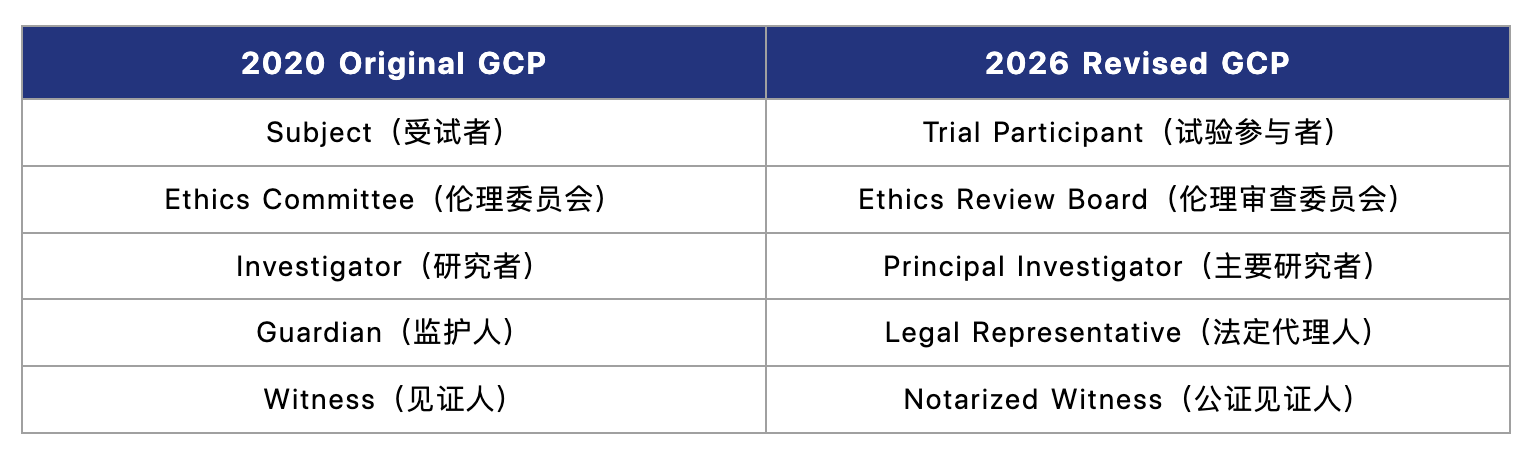
1. Refinement of the Core Terminology System
The 2026 Revised GCP standardizes and revises a number of core terminologies, which directly affects the full set of sponsor documents, including clinical trial protocols, informed consent forms (ICFs), safety reports, and filing documents. Pharmaceutical companies are advised to finalize updates to their relevant document templates in line with the newly effective 2026 Revised GCP.
2. Adherence to ICH GCP principles
The 2026 Revised GCP consists of six chapters and fifty-four articles. To facilitate international regulatory harmonisation and eliminate redundant provisions, the revision adds a dedicated chapter on data governance, removes standardized and detailed requirements that are already specified in the ICH GCP (e.g., trial protocols, investigator brochures, and essential document management), and significantly streamlines the terminology and definition section.
The 2026 Revised GCP establishes a clear trend in the enforcement of quality management for clinical trials: it serves as the fundamental framework and bottom-line requirement for clinical trials, while ICH GCP provides detailed technical operational guidelines.
For sponsors, the compliance standards for international multi-center clinical trials (IMCTs), the international launch of innovative drugs, and the domestic acceptance of overseas trial data are now aligned with international standards, thereby effectively reducing the costs of cross-border pharmaceutical R&D.
3. Reallocation of Rights and Obligations
Article 19 of the 2026 Revised GCP clarifies that the principal investigator is the person ultimately responsible for clinical trials at the site. Such person is accountable for the rights, interests and safety of trial participants as well as the overall quality of clinical trials. Nevertheless, the performance of these duties by principal investigators does not exempt the sponsor from its ultimate legal liability for clinical trial activities, nor does it otherwise mitigate that liability, specifically:
-
The sponsor is ultimately responsible for all clinical trial-related activities and bears full and non-delegable regulatory obligations throughout the entire lifecycle of the trial. The sponsor shall exercise continuous supervision, inspection and management over: (a) the selection and on-going performance of service providers (including CROs and any further subcontracted activities); (b) the rights and obligations of all trial participants; and (c) the quality of execution at every stage of the trial.
-
With respect to the industry’s previously prevalent practice of having SMO or third-party personnel perform key trial functions in place of the principal investigator, the sponsor must address this oversight deficiency by implementing a comprehensive contractual arrangement and exercising continuous on-site management, monitoring, and inspection of site, the site’s delegation of authority, and the vendor personnel operating within it.
-
The sponsor must implement risk-based full-process quality management and supervision, conduct audits proportionate to the risks inherent in the trial, identify risks that may affect critical quality indicators, and formulate control measures proportionate to the potential impact of risks on trial participant safety and data reliability. The sponsor shall report potential serious safety risks to regulatory authorities in accordance with the proportionality principle, and establish a hierarchical risk management mechanism. The sponsor can no longer adopt a one-size-fits-all approach to compliance.
4. Enhanced Protective Framework for Trial Participants
The 2026 Revised GCP introduces a change in terminology from “subject” to “trial participant”, and strengthens the compliance standards for ICFs in three aspects: documentation requirements, scope of content, and the codification of rights and responsibilities:
i. Ethical Review and ICF Content Restrictions
The 2026 Revised GCP mandates rigorous ethical review by ERBs and expressly prohibits ICFs from containing any clauses that: (a) waive the legitimate rights and interests of trial participants; or (b) exempt any party involved in a clinical trial from their statutory liabilities.
ii. Compensation Transparency
ICFs must clearly and reasonably specify the compensation method, amount and implementation plan for trial participants, and all compensation arrangements must be reasonable.
iii. Liability Allocation vs. Statutory Exemption
While ICFs cannot unilaterally exempt or transfer statutory liabilities, the sponsor may contractually allocate internal responsibilities, compensation-sharing obligations, and recourse mechanisms with other trial parties, thereby enabling advance risk mitigation without circumventing mandatory legal duties.
These ICF-centered revisions further improve the protection of participants’ rights, safety and well-being, establishing a regulatory principle that prioritizes the rights and interests of trial participants, thereby advancing informed consent in clinical trials to substantively protect the trial participants’ rights.
5. Standalone Data Governance Provision
Data authenticity and traceability are the cornerstones of credible clinical trials. The 2026 Revised GCP introduces, for the first time, a chapter on data governance, establishing a closed-loop system for end-to-end data compliance. The sponsor is obligated to ensure that all parties involved in clinical trials strictly adhere to the data governance requirements outlined in the 2026 Revised GCP, and is ultimately responsible for the quality of data throughout the entire process. The key provisions are as follows:
i. Data Traceability
Trial data acquired from any source, including data captured in computerized systems, must be accompanied by corresponding metadata and audit trails to ensure full traceability throughout the process.
ii. Correction Integrity
Data corrections must be made promptly, documented, and traceable. Overwriting or deleting raw data is strictly prohibited to prevent covert data tampering.
iii. Transmission Security
Validated data transmission systems must be adopted to guarantee the reliability, traceability and security of transmitted electronic data and relevant metadata.
iv. Access Control and Accountability
Computerized systems must implement user management, tiered access, and audit trails. Access to the system is restricted to duly authorized users only, and all operations must be attributed to identified individuals to ensure full accountability.
6. Refined Rules for Document and Sample Retention
The 2026 Revised GCP largely inherits the core document retention requirements of the 2020 Original GCP, with key updated provisions for the sponsor as follows:
-
For investigational drugs that have been approved for marketing, all relevant documents, including ERBs and clinical trial documents, must be retained for five years after marketing approval.
-
Dedicated management systems must be established for trial drugs used in bioequivalence trials. Pharmaceutical companies are recommended to formulate standardized documents and sample retention mechanisms through internal management systems and contractual clauses.
III. Strategic Implications and Compliance Roadmap for Sponsors
The 2026 Revised GCP ushers China’s clinical trial regime into a new era, one defined by risk-based oversight, comprehensive compliance, sponsor accountability, and ICH harmonization. The regulatory paradigm has shifted from monitoring the conduct of individual sites to imposing end-to-end compliance liability on the sponsor, significantly elevating standards for R&D governance, vendor oversight, data stewardship, and dispute prevention:
1. Document System Update
Update the terminology and, where applicable, revise the core documents used under the 2026 Revised GCP framework, including informed consent forms, trial protocols, safety reports and standardized templates.
2. Third-Party Risk Management & Contractual Safeguards
Strengthen the criteria for selecting CROs and other vendors, enhance the contractual provisions on subcontracting controls, data accountability, liability for breach of contract, and risk mitigation clauses, and ensure the sponsor fulfills its oversight obligations over all delegated functions.
3. Internal Risk Control and Audit Framework
Implement an end-to-end risk management mechanism that covers hierarchical risk control, audit management, safety incident response and Development Safety Update Report (DSUR) reporting, all of which must be aligned with ICH GCP requirements.
4. Data Compliance Remediation
Conduct a comprehensive risk assessment of the EDC system, data retention practices, operational traceability and cross-border data transmission to establish a periodic data self-inspection mechanism.
5. Participant Protection Enhancement
Refine compensation schemes and risk disclosure procedures, eliminate standard liability waiver clauses, and implement proactive measures to mitigate exposure to civil disputes.
IV. Conclusion
The 2026 Revised GCP is more than a regulatory update. It is a fundamental realignment of China’s clinical trial ecosystem in line with international standards, and it requires pharmaceutical companies to fundamentally upgrade their R&D compliance infrastructure.
Going forward, clinical trial compliance will no longer be a mere box-checking exercise. It will be an end-to-end risk management imperative throughout the entire project lifecycle. Pharmaceutical companies, as the sponsors, shall decisively implement remediation actions with respect to the legacy trials and design new projects under the revised framework in order to remain compliant, efficient and integrated into the global drug development arena.