Introduction
On April 10, 2026, the Supreme People's Court and the Supreme People's Procuratorate (the "Two Supremes") jointly issued the Interpretation on Several Issues Concerning the Application of Law in Handling Criminal Cases of Corruption and Bribery (II) (hereinafter referred to as "Interpretation (II)"). As the first "sequel" a decade after the promulgation of the 2016 Interpretation on Several Issues Concerning the Application of Law in Handling Criminal Cases of Corruption and Bribery (hereinafter referred to as "Interpretation (I)"), Interpretation (II) has attracted widespread attention. Interpretation (II) explicitly defines, for the first time, the thresholds for criminalization and penalty escalation for crimes such as the acceptance of bribes by a unit, offering bribes to a unit, offering bribes by a unit, introducing a bribe, and concealing overseas deposits. At the same time, it comprehensively aligns the conviction and sentencing standards for duty-related crimes in the non-public sector—such as a non-state functionary accepting bribes and occupational embezzlement—with similar crimes committed by state functionaries, and it responds to practical challenges such as options corruption, the valuation of specific properties, and rules for the recovery of illicit gains. The above changes pose entirely new challenges for corporate criminal compliance management. Drawing on our experience in handling related cases, this article details the core content of Interpretation (II) and the key risk points that enterprises should focus on.
I. Why should we pay attention to Interpretation (II)?
Reviewing the development of China's anti-corruption criminal judicial interpretations, the 1999 Supreme People's Procuratorate's Provisions on the Standards for Filing Cases Directly Received and Investigated by the People's Procuratorates (Trial) systematically clarified the monetary thresholds for filing cases of various corruption and bribery crimes, providing a basic guideline for early judicial practice. The 2003 Supreme People's Court's Summary of the Symposium of National Courts on the Trial of Economic Criminal Cases ("Summary of Economic Crimes") further detailed the rules for determining the subjects of corruption, bribery, and dereliction of duty crimes, the standards for consummated and attempted crimes, and the determination of complex issues such as stock bribery.
In 2007, the Two Supremes jointly issued the Opinions on Several Issues Concerning the Application of Law in Handling Criminal Cases of Accepting Bribes ("Opinions on Accepting Bribes"), which systematically stipulated ten types of new, concealed bribery acts, such as transaction-based bribery, accepting dry shares, co-investment bribery, and entrusted wealth management bribery, marking a substantive expansion of the anti-corruption criminal network toward "hidden corruption." In 2008, the Two Supremes issued the Opinions on Several Issues Concerning the Application of Law in Handling Criminal Cases of Commercial Bribery, clarifying the eight charges involved in commercial bribery crimes and defining the determination of commercial bribery crimes in fields such as healthcare and education. In 2013, the Two Supremes issued the Interpretation on Several Issues Concerning the Specific Application of Law in Handling Criminal Cases of Offering Bribes ("Interpretation on Offering Bribes"), which clarified the conviction and sentencing standards, conditions for lenient punishment, and the rules for determining "seeking illegitimate benefits" in the crime of offering bribes, further improving the legal application system for bribery crimes.
In 2016, Interpretation (I) was promulgated, making comprehensive and systematic provisions on the monetary tiers (30,000 / 200,000 / 3 million RMB), penalty configurations, and new scenarios of bribery for the crimes of corruption and accepting bribes, becoming the core basis for anti-corruption criminal trials over the subsequent decade. However, the focus of this interpretation was mainly on crimes committed by natural persons; the monetary standards for crimes such as unit bribery, introducing a bribe, and concealing overseas deposits were not explicitly stipulated and needed further clarification. At the same time, as the anti-corruption campaign deepens, new and hidden methods of corruption such as options corruption, shareholding by proxy, and specific properties (calligraphy, paintings, jade, luxury watches) continue to evolve. Some rules of the 2003 Summary of Economic Crimes and the 2007 Opinions on Accepting Bribes could no longer adapt to practical needs, such as the issue of determining expected return-based bribery, which will be introduced later.
Interpretation (II) emerged precisely against this backdrop. It is not a simple patch to Interpretation (I), but a systematic supplementation and improvement of areas such as unit bribery crimes, duty-related crimes involving personnel in the non-public enterprises , the determination of new hidden corruption, and rules for recovering illicit gains and returning stolen goods. All the aforementioned multiple judicial interpretations and documents form the current complete judicial interpretation framework for punishing corruption and bribery crimes, mutually supplementing and complementing each other.
II. Implemented on May 1st? How does it apply to actions before it takes effect?
Article 24 of Interpretation (II) states, "This Interpretation shall come into effect on May 1, 2026. Where judicial interpretations previously issued by the Supreme People's Court and the Supreme People's Procuratorate are inconsistent with this Interpretation, this Interpretation shall prevail." Regarding the determination of conduct occurring before it takes effect, according to the Provisions of the Supreme People's Court and the Supreme People's Procuratorate on the Time Validity of the Application of Criminal Judicial Interpretations, the validity of a judicial interpretation applies during the enforcement period of the law. If there were no clear prior provisions regarding the relevant content before its implementation, the judicial interpretation can apply retroactively; only if there were prior related provisions will the rule of "retroactive application of the lighter penalty" (Lex Mitior) apply[1].
For example, the retrospective application of the provisions of Interpretation (II) is as follows:
-
Newly added provisions: For example, the criteria for "especially serious circumstances" for the crime of a unit accepting bribes (2 million RMB), the criteria for "serious circumstances" for the crime of offering bribes to a unit (2 million RMB for individuals / 4 million RMB for units), and the criteria for "especially serious circumstances" for the crime of a unit offering bribes (2 million RMB) are newly added provisions and can apply retroactively.
-
Lighter new provisions: For example, the thresholds for criminalizing the crime of a unit accepting bribes and the crime of offering bribes to a unit have been increased, which can apply retroactively.
-
Provisions following past practices: For example, the determination standards and criminalization amounts for the crime of a unit offering bribes are not entirely new provisions, so they can generally also apply to actions before the implementation of the judicial interpretation.
III. Unit offering bribes: Determination standards are tightening, is the compliance defense still effective?
Article 4 of Interpretation (II) clarifies the monetary standards for the crime of a unit offering bribes and the circumstances for determining "serious circumstances" and "especially serious circumstances." Regarding the determination standards for the crime of a unit offering bribes, the new rule continues the consistent principle in judicial practice of "unit will + unit benefit," meaning that if the action is decided collectively by the unit or decided by the actual controller or responsible personnel, and the illicit gains belong to the unit, it is identified as the crime of a unit offering bribes.
The determination of a unit's collective decision is usually not heavily disputed, but whether the actions of the legal representative or responsible personnel can be attributed to the unit, especially when their actions violate the company's internal rules and regulations, is a point of divergence in practice. Current mainstream judicial views lean towards: as long as the actor possesses the corresponding authority granted by the unit, even if their actions formally violate company regulations, they may still be identified as a unit action. There are precedents where bribery acts committed by a regional sales manager to meet performance targets were identified as a unit crime.
Based on our recent experience handling cases, the judicial organs' review of unit compliance defenses is becoming increasingly strict. The traditional defense of "personal employee action, strictly prohibited by the company" is now difficult to exclude unit liability. Enterprises must comprehensively prove the following: a sound compliance management organizational structure, targeted compliance policy documents, continuous training and communication, effective internal oversight and reporting mechanisms, and most crucially—whether past violations have been strictly investigated and penalized internally. If an enterprise has never discovered or handled any violations, or even discovered them but treated them lightly, its compliance system is highly likely to be deemed "paper compliance," unable to prevent the establishment of unit criminal liability. Enterprises should take this opportunity to move from "paper compliance" to "substantive compliance" and build a truly effective anti-commercial bribery management system.
In terms of monetary standards, the 200,000 RMB threshold for the crime of a unit offering bribes has long been applied in practice. The current Interpretation (II) explicitly confirms this and adds provisions that 100,000 RMB is sufficient for criminalization in five specific situations (such as bribing three or more people, using illicit gains for bribery, bribing in specific livelihood sectors like healthcare). It also newly adds the "especially serious circumstances" tier of 2 million RMB or more, filling the previous gap in standards for penalty escalation.
IV. Offering bribes to a unit: State-owned entities and internal departments becoming high-risk zones for criminal liability?
Interpretation (II) sets provisions from both the briber's and the recipient's perspectives regarding the criminal liability for offering bribes to state-owned units such as state organs, state-owned enterprises, and public institutions. For the crime of a unit accepting bribes, the original threshold of 100,000 RMB[2] is raised to a bribe amount of 200,000 RMB (halved for specific circumstances); for the crime of offering bribes to a unit, the original thresholds of 100,000 RMB (individual bribery) and 200,000 RMB (unit bribery)[3] are raised to 200,000 RMB and 400,000 RMB respectively (halved for specific circumstances), and it explicitly states that personal bribery of 2 million RMB or more, unit bribery of 4 million RMB or more, or lower amounts combined with specific circumstances, will be identified as "serious circumstances."
The increased thresholds for criminalization do not mean that criminal liability is lessened; the criminal risk of offering bribes to a unit is often underestimated by enterprises in practice. On one hand, some business operators have a misconception that "giving benefits to a unit" is less risky than "giving benefits to an individual." On the other hand, Article 7 of the Anti-Unfair Competition Law revised in 2017 excluded transaction counterparties from the subjects of commercial bribery (transaction counterparties in special fields like hospitals and schools might be identified as parties with influence over the transaction), leading some enterprises to mistakenly believe that the criminal field had also simultaneously relaxed. However, there is a fundamental difference in the determination standards between crimes and unfair competition acts—as long as the target of the bribery is a state-owned unit, it may trigger the crime of offering bribes to a unit.
What deserves particular attention is that internal departments of state-owned units can also become the recipients of bribes in the crime of offering bribes to a unit. In judicial practice, internal departments of public hospitals (such as the pharmacy, equipment, and IT departments), internal faculties of public schools, and internal functional departments of state-owned enterprises have all been identified by legal precedents as qualified subjects for unit bribe acceptance. Taking the healthcare sector as an example, if a pharmaceutical company directly gives kickbacks or sponsorships to a department of a public hospital, even if the funds do not enter the hospital's official accounts and are only controlled by the department, it may still be identified as the crime of offering bribes to a unit.
Therefore, when conducting business with state-owned units and their internal departments, enterprises must strictly review the compliance of various arrangements such as sponsorships, donations, and service fees to avoid falling into criminal risks due to misjudging the scope of a "unit." It is recommended that enterprises establish a special compliance review mechanism for transactions with state-owned units and implement focused controls over financial transactions involving internal departments of state-owned entities.
V. How is the criminal liability of non-state functionaries determined?
Article 8 of Interpretation (II) explicitly stipulates that the conviction and sentencing standards for the crime of a non-state functionary accepting bribes, the crime of offering bribes to a non-state functionary, the crime of occupational embezzlement, and the crime of misappropriation of funds shall refer to the corresponding standards for the crime of accepting bribes, the crime of offering bribes (including the crime of a unit offering bribes), the crime of corruption, and the crime of misappropriation of public funds, respectively, reflecting equal protection for enterprises of different ownership structures.
Article 11 of the 2016 Interpretation (I) once adopted a multiplier-based differentiated approach to the starting amounts for the aforementioned non-state functionary crimes: "relatively large amounts" and "huge amounts" in the crimes of non-state functionaries accepting bribes and occupational embezzlement were executed at two times and five times the corresponding monetary standards for the crimes of accepting bribes and embezzlement, respectively; the starting amounts for the crimes of misappropriation of funds and offering bribes to non-state functionaries were executed at two times the monetary standards for the crimes of misappropriation of public funds and offering bribes. The new regulations significantly lower the criminal thresholds for crimes involving non-state functionaries.
Unifying the monetary standards for crimes committed by state functionaries and non-state functionaries is a major trend in legislation and judicature. In 2022, the Provisions of the Supreme People's Procuratorate and the Ministry of Public Security on the Standards for Filing and Prosecuting Criminal Cases under the Jurisdiction of Public Security Organs (II) took the lead in lowering the case-filing standards for crimes such as non-state functionaries accepting bribes, offering bribes to non-state functionaries, and occupational embezzlement to the 30,000 RMB level, which is the same as similar crimes committed by state functionaries, from the perspective of case filing and prosecution. The current Interpretation (II) essentially fills the long-standing gap between the public security case-filing standards and judicial sentencing standards. Furthermore, the 2024 Criminal Law Amendment (XII) further expanded the criminal subjects of crimes such as operating competing businesses illegally, illegally seeking profits for relatives and friends, committing malpractice to convert shares at a low price, and selling state-owned assets, to include personnel of general enterprises.
For enterprises, on the one hand, internal anti-fraud measures and the protection of their own rights have gained more powerful legal weapons and operational tools; utilizing the significantly enhanced pressure of criminal prosecution, enterprises can more effectively stop and pursue internal fraud. On the other hand, in external business interactions, enterprises must also incorporate business dealings with non-state functionaries (such as procurement or technical personnel of client companies) into the focus of compliance management to prevent criminal risks such as bribery.
VI. Target of recovery extends to the briber: Can promised but unpaid funds be recovered?
Article 23, Paragraph 3 of Interpretation (II) stipulates: "Where illicit money or goods have not yet been delivered to the bribe recipient or have been returned to the briber, they shall be recovered from the briber according to the law." This provision systematically achieves a breakthrough in the system of recovering criminal property—the target of recovery expands from the traditional bribe-receiving party to the bribe-offering party, forming a recovery system of "original object → converted object → equivalent property → briber / third party."
In practice, there have been cases where the briber promised to pay kickbacks to state functionaries, but had not yet actually delivered them, and supervisory organs still pursued the recovery of the promised amount. This practice raises a question: do "promised funds" that have not been delivered constitute "illicit money or goods"? From a legal nature perspective, "bribery" in bribery crimes takes actual payment as a constituent element, and a mere "promise" generally does not constitute a completed crime of offering bribes. However, two levels must be distinguished: recovering illegal gains does not premise upon a completed crime. Under Article 64 of the Criminal Law, possessions of the criminal that are used in the commission of the crime shall be confiscated. Even if the bribe funds have not been actually delivered, as long as there is evidence proving that the funds were prepared for seeking illegitimate benefits, the supervisory organ has a legal basis to take property preservation measures.
The legislative purpose of Interpretation (II) is to maximally strip the profits of corruption and prevent anyone from benefiting from corrupt acts. The takeawayfor enterprises is: the risk of bribery not only involves the pursuit of criminal liability but also extends to the deprivation of economic interests. Enterprises should establish a strict approval system for commercial transactions to avoid falling into the dual risks of criminal liability and economic loss due to acts such as promising kickbacks or rebates.
VII. How can bribers seek lenient treatment under the background of investigating both bribe-takers and bribers together?
In September 2021, six departments including the Central Commission for Discipline Inspection and National Supervisory Commission, the Central Political and Legal Affairs Commission, the Supreme People's Procuratorate, and the Supreme People's Court jointly issued the Opinions on Further Promoting the Joint Investigation of Bribe-Takers and Bribers, reflecting the state's long-standing attitude of severely cracking down on bribery crimes. Despite this, the law still provides a path for bribers to receive lenient treatment that is more favorable than voluntary surrender or meritorious service.
For the crime of offering bribes, according to Article 389 of the Criminal Law, giving property to state functionaries due to extortion without obtaining illegitimate benefits does not constitute offering a bribe. According to Article 390 of the Criminal Law, if a briber voluntarily confesses the bribery act before being prosecuted, they may be given a lighter or mitigated punishment. Among them, if the crime is relatively minor and plays a key role in the investigation breakthrough or solving a major case, or if there is a major meritorious performance, the punishment may be mitigated or exempted. For the crime of offering bribes to non-state functionaries, Article 164 of the Criminal Law also stipulates that if a briber voluntarily confesses the bribery act before being prosecuted, the punishment may be mitigated or exempted.
According to the Interpretation on Offering Bribes and Interpretation (I), the specific determination standards for the above lenient treatment are as follows:
-
"Before being prosecuted" refers to before a criminal case is filed against the briber. In practice, even if the briber is placed under liuzhi (retention in custody), as long as a criminal case has not yet been filed, there is still room to strive for lenient treatment.
-
"Relatively minor crime" refers to situations where the penalty might be fixed-term imprisonment of less than three years. For the crime of offering bribes, a bribe amount under 1 million RMB generally falls within the sentencing range of under three years of fixed-term imprisonment.
-
"Major cases" include bribery crimes that may be sentenced to fixed-term imprisonment of ten years or more. For the crime of accepting bribes, a bribe amount exceeding 3 million RMB fits the sentencing range of ten years or more. In addition, cases with a significant impact within a provincial administrative region or nationwide may also meet the standards for a major case.
-
"Playing a key role in solving major cases" includes situations where the voluntary confession of bribery facts plays an important role in gathering evidence for a major case, or the voluntary confession of bribery facts plays an important role in pursuing fugitives or recovering stolen goods in a major case.
Interpretation (II) did not modify the relevant rules regarding lenient treatment for bribers. It is recommended that individuals involved in cases accurately grasp current legal provisions, voluntarily confess bribery acts before prosecution, and actively cooperate with investigations and the return of illegal gains to strive for lenient treatment of lighter, mitigated, or even exempted punishment.
VIII. How is the amount of special bribes such as gold/silver jewelry and expected stock returns determined?
Articles 11 and 12 of Interpretation (II) make provisions on the determination of the bribe amount. In principle, the bribe amount is generally determined according to the property's value at the time the property was received. If expected returns on stocks or equity are used as the form of bribery, the bribe amount is determined by the actual profit at the time the case is discovered; if actual profits have not yet been realized by the time the case is discovered, it is determined by the premium of the market price of the involved asset over the payment price at the time the case is discovered. This rule changes the traditional practice for "dry shares" bribery crimes, which previously used the "time of the receiving act" as the point for value calculation.
According to relevant judicial interpretations and documents, for expected return-type bribery, China previously used the "time of receipt" or "time of sale" as the time for determining the bribery amount. Interpretation (II) has shifted the time for determining the bribery amount back to the "time of discovery of the case"; whether it is actually sold for profit or held unsold, the bribe amount is calculated based on the market premium at the time the case is discovered. This means that even if the actor paid the capital principal, the massive premium after listing might still be fully included in the bribe amount, substantially increasing sentencing risks.
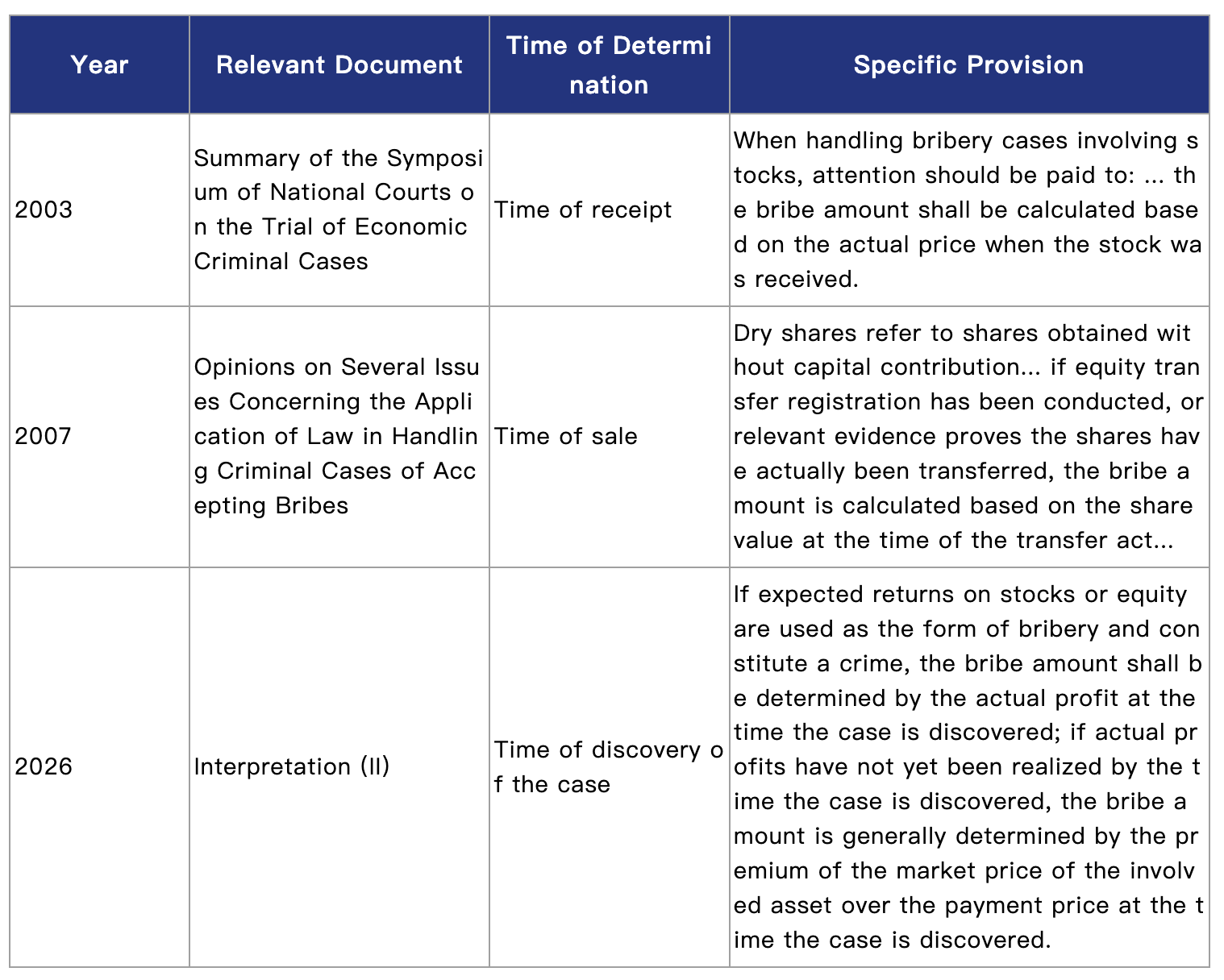
It is worth noting that the specific definition of the node "time of the discovery of the case" (the date of discovering clues, the date of case filing, or the date of liuzhi) has not yet been clarified, and different nodes may lead to huge disparities in asset valuation, which awaits further unification in future judicial practice. Enterprises should carefully evaluate the risk of being identified as disguised transfer of benefits when designing business arrangements such as equity incentives and project collaborations.
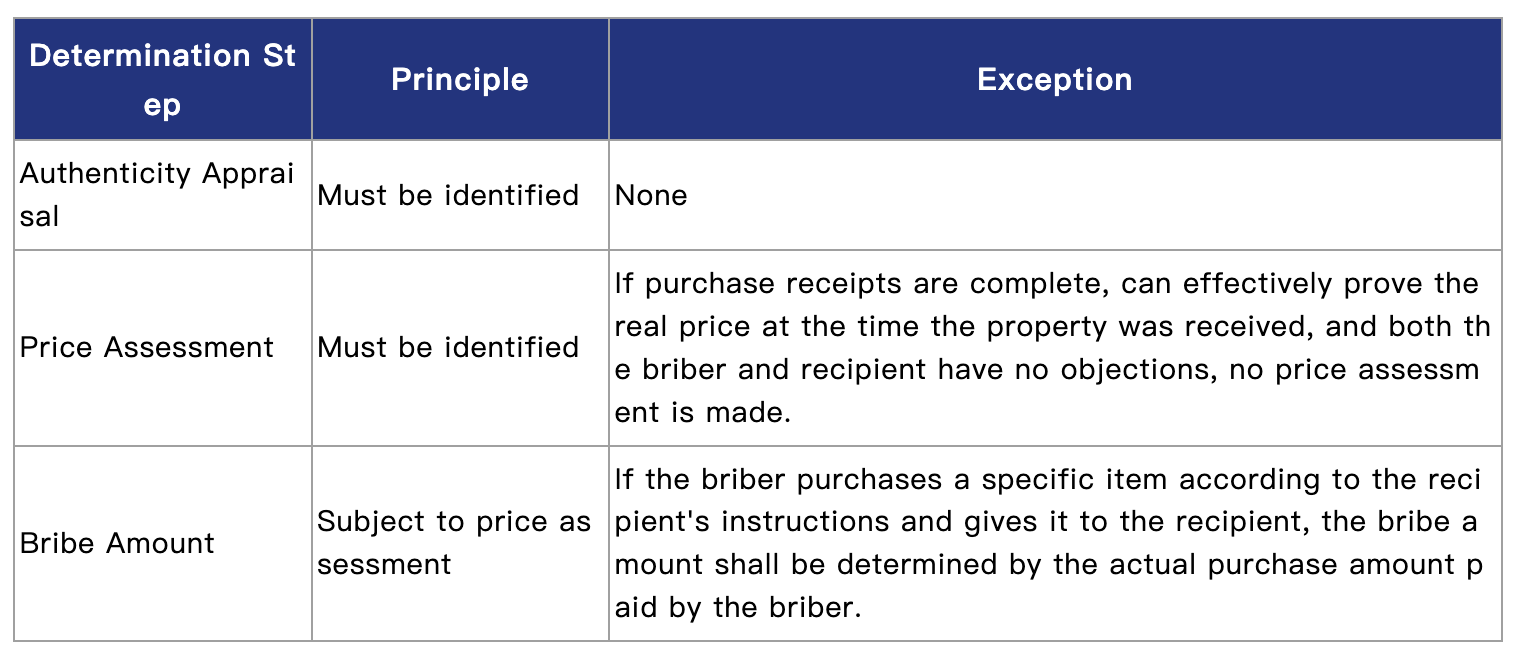
In addition, Interpretation (II) also makes provisions on the value determination of property of unknown authenticity and specific property (jewelry, jade, calligraphy and paintings, watches, precious metals, etc.), as shown in the table below:
IX. Arrest or Liuzhi: How to distinguish jurisdiction for corruption and bribery crimes?
The jurisdictional authority for embezzlement and bribery criminal cases depends on whether the subject of the crime is a public official stipulated by the Supervision Law. According to Article 21 of the Provisions on Jurisdiction by the National Supervisory Commission (Trial), "If persons other than public officials are suspected of the crimes listed in Articles 16 and 17, the crime of offering bribes to non-state functionaries, or the crime of offering bribes to foreign public officials or officials of international public organizations, they shall fall under the jurisdiction of public security organs." This means that commercial bribery crimes committed by actors in the non-public sector, such as private enterprise employees receiving kickbacks or offering bribes to employees of other companies, will be filed and investigated by public security organs according to the procedures for economic criminal cases; whereas embezzlement and bribery crimes involving public officials (including state organ personnel, state-owned enterprise management personnel, and management personnel in public education, science, culture, health, and sports institutions) fall under the exclusive jurisdiction of the Supervisory Commission.
What deserves special attention is that, according to Article 24 of the Supervision Law, when the Supervisory Commission investigates duty crimes of public officials, it has the authority to concurrently apply liuzhi (retention in custody) to and investigate the briber and other involved persons who are not public officials. In other words, even if the briber is a private business owner or an ordinary citizen, as long as the recipient of their bribe is a public official, the briber also faces the legal consequence of being subjected to liuzhi and investigated by the Supervisory Commission. Moreover, non-management personnel in state-owned enterprises or public institutions who hold Party membership may also be subjected to disciplinary review by the Discipline Inspection Commission first, during which relevant enterprises may also be required to cooperate with the investigation.
According to the relevant provisions of the Supervision Law, the Supervisory Commission enjoys strong investigative authority during investigations. Specifically, the supervisory organ can require relevant enterprises to submit evidentiary materials and take measures against involved personnel such as liuzhi, forced appearance, ordering to await investigation, and custody. Among them, the conditions for applying liuzhi are broader than those for criminal detention and arrest, and the maximum liuzhi period can reach fourteen months (far exceeding the eight months and seven days of arrest plus criminal detention). More crucially, the person under liuzhi cannot meet with a defense lawyer during the liuzhi period; the right to defense can only be fully exercised after the case is transferred to the procuratorial organ for review and prosecution.
Therefore, for enterprises, once involved in bribery cases with public officials, the first entity they usually face is the investigation by the Discipline Inspection Commission and the Supervisory Commission. Understanding the characteristics of supervisory procedures, the boundaries of rights protection, and coping strategies holds important practical significance.
X. Which industries are key areas for anti-corruption criminal compliance?
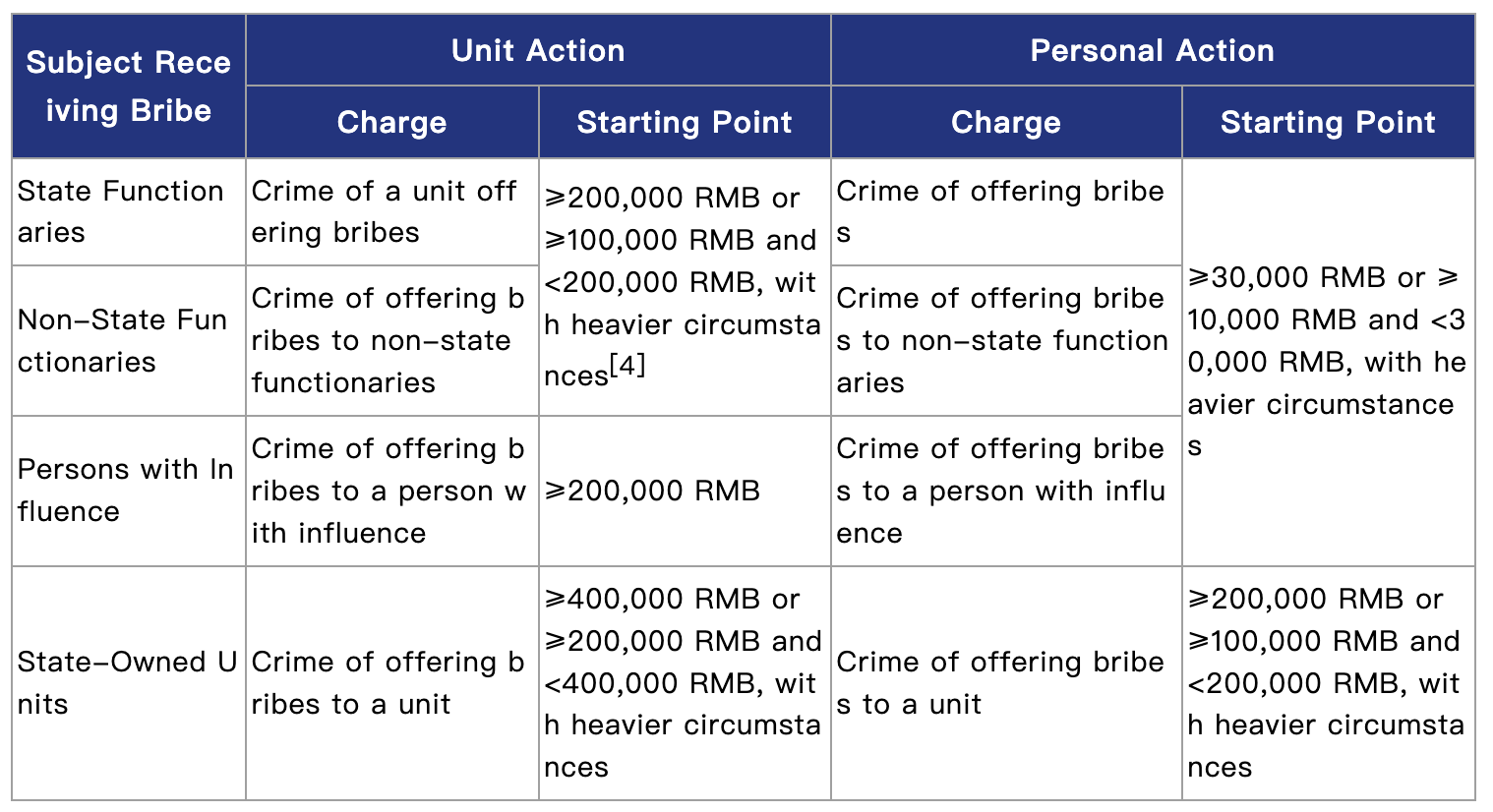
Interpretation (II) explicitly states that if the crime of offering bribes to a unit or the crime of a unit offering bribes involves carrying out illegal and criminal activities by bribing in sectors such as the ecological environment, finance, workplace safety, food and drugs, disaster relief, social security, education, and healthcare, these circumstances will serve as the basis for a heavier punishment. This provision essentially follows the provisions of Criminal Law Amendment (XII) on circumstances for heavier punishment for the crime of offering bribes. Criminal Law Amendment (XII) came into effect on March 1, 2024, and one of its focuses was the addition of seven circumstances for heavier punishment; the aforementioned bribery in livelihood sectors belongs to this category. For cases with circumstances for heavier punishment, the monetary standard for the criminalization threshold or for entering the next penalty tier is generally lowered to about half of that for cases without circumstances for heavier punishment. For example, the starting points for punishment of bribery-type crimes are shown in the table below:
On January 14, 2026, the Communiqué of the Fifth Plenary Session of the 20th Central Commission for Discipline Inspection proposed deepening the rectification of corruption in key areas such as finance, state-owned enterprises, energy, education, academic societies and associations, development zones, and bidding and tendering; strictly investigating and punishing issues such as government-business collusion, power providing protection for capital, and capital infiltrating the political sphere; and deeply investigating new and hidden types of corruption such as expected returns, proxy holding agreements, and the political-business "revolving door." This deployment is highly consistent with the legislative spirit of Interpretation (II).
For enterprises, the above provisions send a clear compliance warning signal.
Enterprises conducting business in livelihood sectors such as food and drugs, healthcare and education, workplace safety, and the ecological environment will face stricter criminal scrutiny regarding arrangements for kickbacks, sponsorships, service fees, and donations in their commercial dealings, with the threshold for criminalization significantly lowered. Furthermore, it is recommended that enterprises conduct special compliance reviews comparing the key areas named in the Communiqué (finance, state-owned enterprises, energy, education, academic societies and associations, development zones, bidding and tendering, etc.), improve internal approval processes, and standardize the boundaries of interactions with public officials, preventing the enterprise from being dragged into criminal risks due to the violations of individual employees.
Conclusion
In summary, Interpretation (II) is not a simple patch to the 2016 Interpretation (I), but a systematic filling and improvement of areas that have long suffered from legal blanks, such as unit bribery crimes, duty-related crimes involving personnel in the non-public sector, the determination of new hidden corruption, and the rules for recovering illicit gains and returning stolen goods. For enterprises, the new rule significantly lowers the threshold for criminalizing internal fraud acts such as occupational embezzlement and bribe-taking in the non-public sector; meanwhile, it extends the recovery risk for the briber from criminal liability to the deprivation of economic interests, making the urgency of compliance management significantly higher. It is recommended that enterprises conduct special compliance reviews as soon as possible based on the new rules and the key areas of Criminal Law Amendment (XII), improve anti-commercial bribery and anti-fraud systems, and ensure that the compliance system moves from "on paper" to "substantive." If involved in relevant cases, they should promptly seek help from professional lawyers to accurately grasp rules of legal application such as the retroactivity of judicial interpretations and "retroactive application of the lighter penalty," legally safeguarding their own rights and interests.
Notes:
[1] Provisions of the Supreme People's Court and the Supreme People's Procuratorate on the Time Validity of the Application of Criminal Judicial Interpretations I. Judicial interpretations are legally binding interpretations made by the Supreme People's Court on specific applications of law in trial work and by the Supreme People's Procuratorate on specific applications of law in procuratorial work; they shall come into effect on the date of promulgation or as specified, and their validity applies during the enforcement period of the law. II. For acts occurring before the implementation of the judicial interpretation, if there was no relevant judicial interpretation at the time of the act, and the case has not yet been processed or is being processed after the judicial interpretation comes into effect, it shall be handled according to the provisions of the judicial interpretation. III. For acts occurring before the implementation of the new judicial interpretation, if there was a relevant judicial interpretation at the time of the act, it shall be handled according to the judicial interpretation at the time of the act; however, if applying the new judicial interpretation is more favorable to the criminal suspect or defendant, the new judicial interpretation shall apply. IV. For cases that have already been concluded before the implementation of the judicial interpretation, if there were no errors in the determination of facts and the application of law according to the law and judicial interpretation at the time, they shall not be altered.
[2] Supreme People's Procuratorate's Provisions on the Standards for Filing Cases Directly Received and Investigated by the People's Procuratorates (Trial)
[3] Supreme People's Procuratorate's Provisions on the Case-Filing Standards for the Crime of Offering Bribes
[4] Heavier circumstances mainly include: (1) offering bribes to three or more subjects; (2) using illegal gains to offer bribes; (3) carrying out illegal and criminal activities by offering bribes in sectors such as the ecological environment, finance, workplace safety, food and drugs, disaster relief, social security, education, and healthcare; (4) offering bribes to seek public office or honorary titles; (5) offering bribes to seek promotion or adjustment in position or rank; (6) causing severe adverse impacts or other serious consequences. There are slight differences depending on the specific charge.